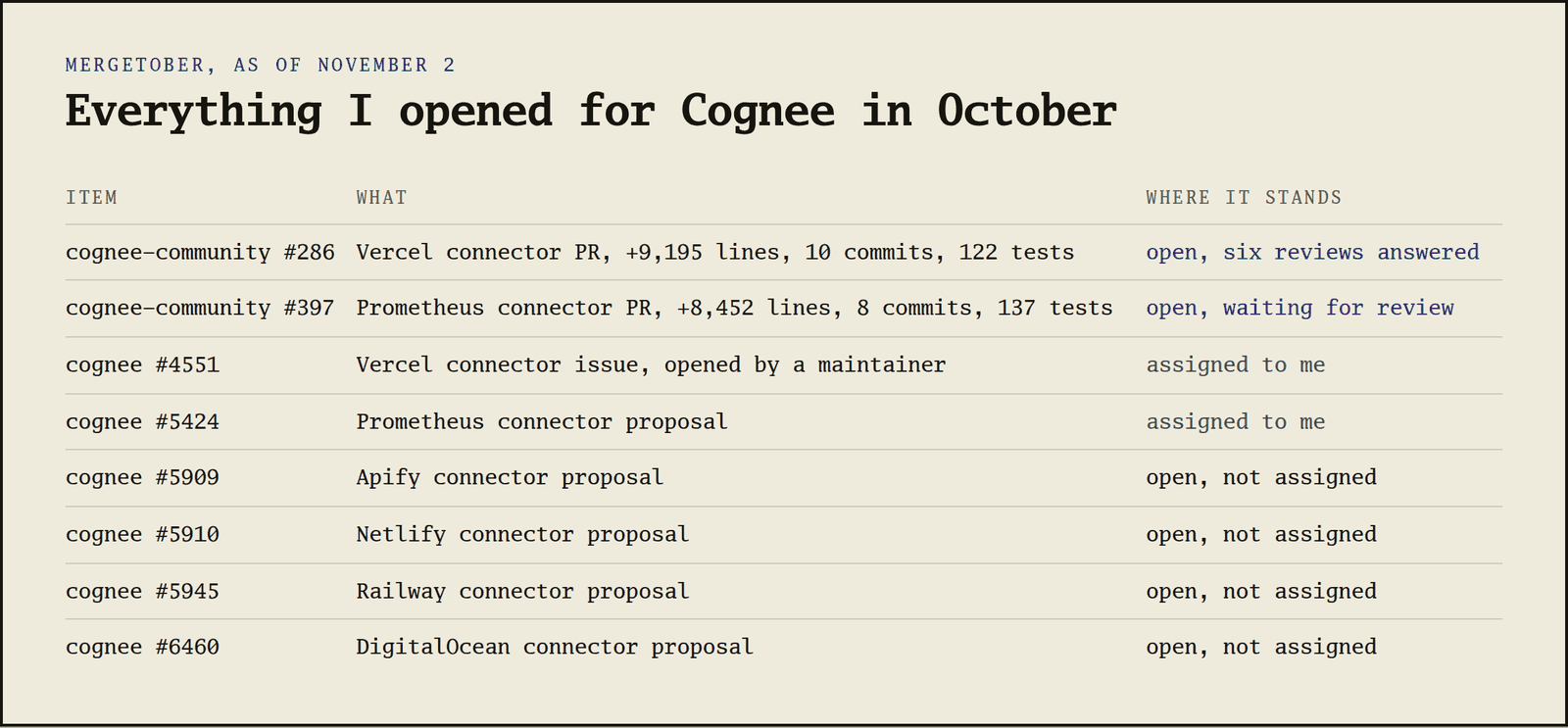
By the end of October I had opened two pull requests and five issues on Cognee. None of them is merged yet. One PR has been through six reviews, the other is waiting for its first, and four of the five proposals are still waiting for a maintainer to say yes.
This is the full list, with what each one is for and what I learned from it.
How Mergetober works
Mergetober is a month of contributions to Cognee, an open source memory layer for AI agents, run with WeMakeDevs. Pull requests had to be opened in October. The work is on issues labelled hackathon, and you have to be assigned before you start. If the source you want has no issue, you write a proposal as a new issue and wait for a maintainer to accept it.
Most of the issues are connectors: code that pulls an outside system into Cognee so an agent can search it. They live in cognee-community and are built on dlt, a Python library for loading data.
The two pull requests
Vercel, cognee-community#286. The issue, cognee#4551, was opened by a maintainer. The connector syncs projects, deployments and, if you turn it on, the logs of failed builds, so an agent can say why a deploy failed. 9,195 lines added, 10 commits, 122 tests. It has had six reviews and 43 inline comments, and most of them were the same kind of bug: memory forgets something and nothing raises an error. That story is in My Vercel connector passed its tests and could still forget your data.
Prometheus, cognee-community#397. This one came from my own proposal, cognee#5424. It syncs alerting and recording rules, and metric metadata if you ask for it, so an agent knows what pages someone and where the runbook is. 8,452 lines added, 8 commits, 137 tests, and no review yet. That story is in Prometheus rules have no id, so I gave them one.
The five proposals
Every proposal I wrote follows the same outline: the problem in one paragraph, the endpoints the connector would call, how it syncs, how it forgets deleted things, and what to watch out for. The last part took the longest, because it means reading the API docs closely enough to find the place where a simple connector would go wrong.
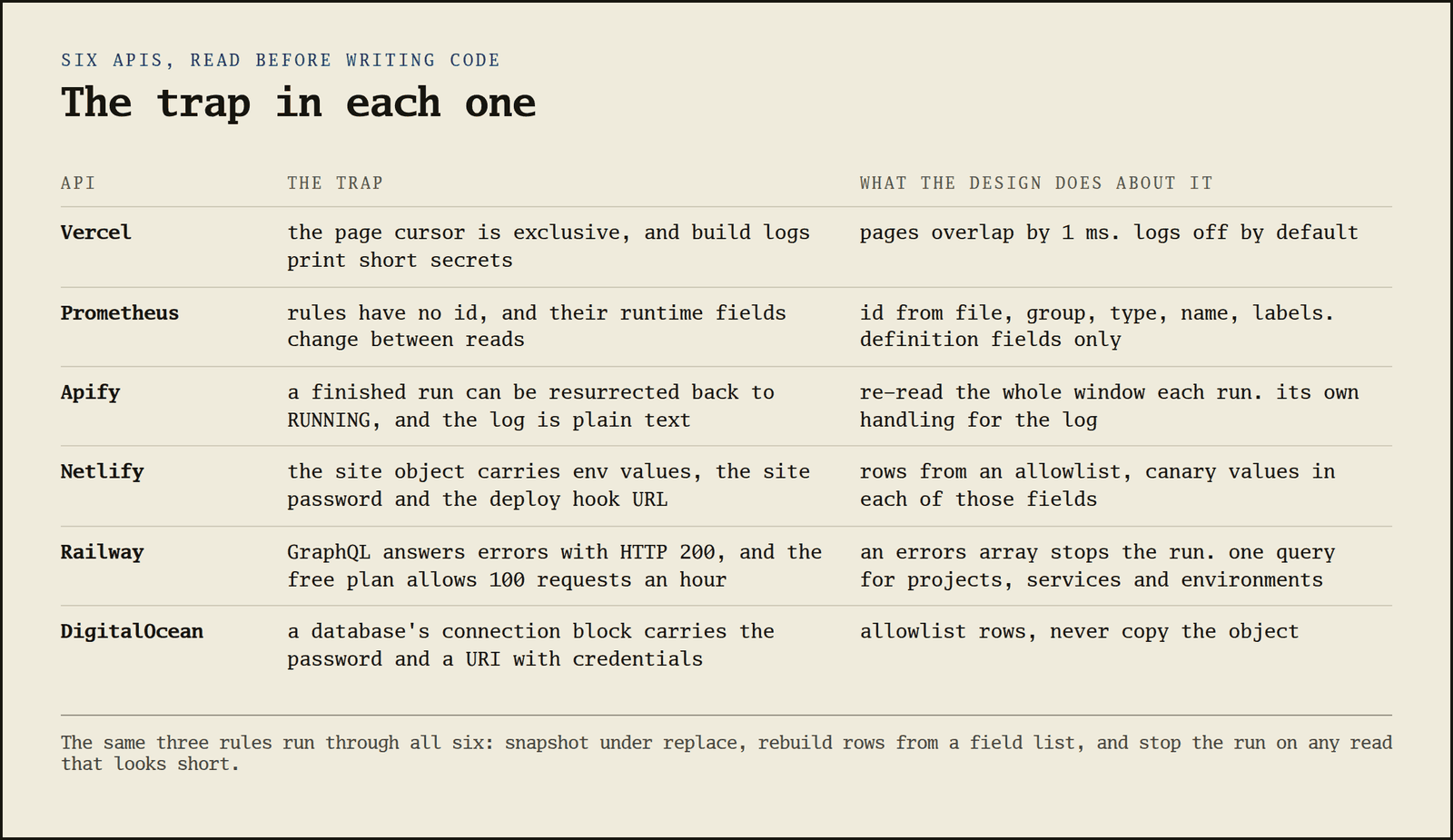
Prometheus, cognee#5424, October 6. Accepted and built, above. Its trap is that rules have no id, and their runtime fields change between reads.
Apify, cognee#5909, October 15. Apify runs scrapers on a schedule. What they collected sits in datasets, and why a run failed sits in its log, both inside Apify Console. The catch is that a finished run can be resurrected back to RUNNING, so a cursor that only moves forward would miss the change. The proposal reads the whole lookback window on each run instead. The log endpoint answers with plain text, not JSON, and run objects carry fields like the caller's IP address, so rows come from an allowlist. Scraper output is arbitrary JSON, so dataset items are opt in, and the user names the fields to keep.
Netlify, cognee#5910, October 15. Netlify holds a site's deploy history: which deploys went live, which failed, on which branch and commit, and what the error said. The site object embeds secrets. build_settings.env holds environment variable values, and the same object carries the site password, the deploy hook URL and the notification email. Rows come from an allowlist, and the tests put canary values in each of those fields. Netlify documents no endpoint for reading build logs, so a failed deploy gets its error message and not its log.
Railway, cognee#5945, October 16. Railway is where many teams run the backend next to a frontend on Vercel. Its API is GraphQL, and GraphQL answers errors with HTTP 200 and an errors array. A connector that only checks the status code would load a failed read as an empty one, and under replace that forgets everything. The free plan also allows 100 requests an hour, so the proposal fetches projects, services and environments in one query, and the README would give the request count for a given setup.
DigitalOcean, cognee#6460, October 30. Droplets, App Platform apps and their deployments, managed databases, Kubernetes clusters, alert policies, uptime checks and the account's action history. The risk sits in ordinary objects. A managed database's connection block carries the password and a URI with credentials, and an app spec carries environment variable values. The answer is the same as for the others. Rows come from an allowlist, never from a copied object, and every secret field gets a canary in the tests.
Three rules that held for all six
Six APIs, two connectors and four more designs ended up resting on the same three rules.
- Read a full snapshot and load it with
replace. Most of these APIs have records that change after they are created, like a build that fails late or a run that is resurrected, and most of them just stop listing a thing that was deleted. A cursor misses both. A snapshot catches both, and unchanged rows keep their id, so keeping them costs nothing. - Rebuild each row from a list of fields. In Vercel, Netlify and DigitalOcean, secrets sit on objects a connector has to read anyway. Copying the whole object puts them in memory without ever calling a secrets endpoint.
- Stop on any read that looks short. Under
replace, a short read that finishes is the same as deleting the rest. A stopped run leaves memory as it was, and the next run reads everything again.
What is next
November is for the two open PRs: answering the next review on #286, and getting #397 its first one. If a maintainer accepts one of the four waiting proposals, the design is already written down, and most of the code is those three rules again.